

BOTANY AND ANTHROPOLOGY
Botanical and Anthropological Characteristics
Ayahuasca is a psychoactive beverage made by boiling two different plant species and used in religious ceremonies or rituals, known by the Incas after Huayna Cápac.
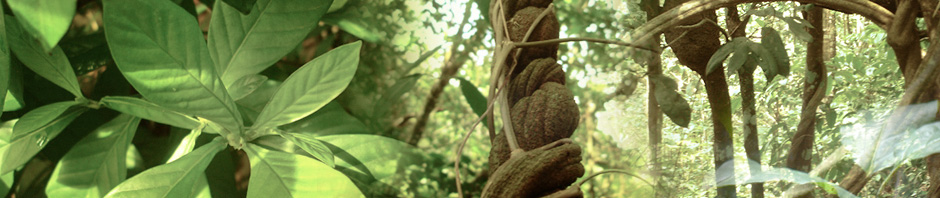
One of the plants is the vine scientifically named Banisteriopsis Caapi, and the other is a shrub of the Rubiaceae family named Psychotria Viridis. In Quechua the plants are known as Mariri, the name of the vine, and Chacruna or Chacrona, the name of the shrub. In the same language the name of the beverage is Ayahuasca — wine of the spirits, of souls, of the dead or of the ancestors.
The beverage is prepared with two plants put to macerate or cook, with various degrees of refinement and concentration. The plants are known by several other denominations, having been used since immemorial times in a vast area and by various indigenous nations separated by great distances, cultural and linguistic differences.
According to Schultes, Richard Evans, and Raffauf, Robert F. — The Healing Forest: Medicinal and Toxic Plants of Northwest Amazonia (1990); Portland, OR: Dioscorides Press — at least 42 indigenous names are known for this potion used by at least 72 indigenous tribes of the Amazon basin.
The antiquity of the use of Ayahuasca is lost in prehistory. From a millenary regional use, centered in the western Amazon, its utilization has had a modern expansion throughout South America, primarily due to its preservation by indigenous peoples and mestizos, despite the incessant cultural repression after the early days of colonization. Much of what is practiced and known regarding Ayahuasca results from observation and empirical knowledge accumulated by the indigenous peoples.
The use of these plants by mestizos generally occurs within the context of ethno-medicine and follows the general principles of traditional native use (shamanic use) with modifications and additions pertaining to the various religious belief systems imported alongside colonization, principally: spiritism, Christianity, Freemasonry, and African cults.
The initial impulse toward a worldwide expansion of the use of Ayahuasca came thanks to general interest in ethnological matters and to the expansion of the great syncretic religious movements of Brazil, organized around the use of Ayahuasca as a sacrament, the largest being "Santo Daime" — the oldest — and the "União do Vegetal (UDV)" among various other denominations.
It is interesting to note that Ayahuasca has been used for centuries by millions of people. Such a period of trial greatly exceeds the standards of studies administered for the approval of drugs and medicines. In most Amazonian cultures, until today, Ayahuasca culturally occupies a high regard alongside other 'master plants' (teachers or instructors) such as Peyote.
During the last twenty years, contemporary socio-anthropological, pharmacological and popular literature has significantly debated the various dimensions and use of Ayahuasca, from a cultural, chemical, psychological and spiritual standpoint.